Marcadores

segunda-feira, 8 de janeiro de 2018

Os judeus da Ucrânia

A Ucrânia tem seu território saturado de memórias judaicas – tanto trágicas quanto sublimes. Em todos os campos de atuação – pensamento religioso, política, arte, música, assuntos militares, ciência – judeus vindos do território em que hoje se situa a Ucrânia registraram grandes realizações. São muitos; entre eles, Goldie Meyerson, que ficou conhecida como a Primeira-Ministra Golda Meir, nasceu em Kiev. Leon Trotsky, nascido Lev Bronstein, arquiteto da revolução russa e fundador do exército vermelho, era de Yanovka.
A Ucrânia está cheia de fantasmas e sangue judeu em seu solo. Mas há vida ali, também: estimativas da população judaica no país variam, e o European Jewish Congress cita entre 360 e 400 mil judeus morando na Ucrânia, o que faria desta a quinta maior comunidade no mundo. Em Agosto de 2017, o reporter Jonathan Spyer, do JPost, visitou o país com a intenção de olhar de perto o impacto que a nova guerra está causando nos judeus ucranianos. O resultado é a matéria abaixo, original do JPost em inglês, que copiamos aqui.  

IN THE LAND OF THE TRIDENT: THE JEWISH COMMUNITY IN UKRAINE

 SEPTEMBER 2, 2017 04:42

Jews, it appears, will be living under the “Tryzub” – the gold trident that forms Ukraine’s national symbol, for some time to come.
 “Ukraine is a territory saturated in Jewish memory – memory both tragic and sublime. In every field of endeavor – religious thought, Zionist and socialist politics, art, music, military affairs, science… Jews from the territory on which the modern Ukrainian state is located have registered outstanding achievement.


It is the birthplace of Rabbi Yisrael ben-Eliezer, the Baal Shem Tov, founder of Hasidic Judaism, who grew up near Kameniec in what is now western Ukraine; Rabbi Nachman of Bratslav, founder of the Breslov Hasidic movement, who was born in Miedzyboz in central Ukraine; Haim Nachman Bialik, the poet laureate of modern Hebrew literature, who was born in Zhitomir, in north central Ukraine. Goldie Meyerson, who became prime minister Golda Meir, was born in Kiev. Israeli-born Moshe Dayan, famed fighter and commander, was the son of Shmuel Dayan, who came from Zhashkiv, in the Cherkassy region, central Ukraine. Isaac Babel, one of the foremost Soviet novelists of the mid-20th century, whose “Red Cavalry Tales” remains a classic of 20th-century Russian literature, came from Odessa. Leon Trotsky, born Lev Bronstein, architect of the Russian revolution and founder of the Red Army, came from Yanovka, in the Kherson region of Ukraine. Vladimir Ze’ev Jabotinsky, father of Revisionist Zionism, came from Odessa. Solomon Rabinovitch, better known as Sholem Aleichem, came from Pereyaslav, in the Kiev governorate. And so on. The area has played host to an astonishing gathering of Jewish creative energies.

It is also prominent among the lands of destruction. Ukraine is the land of Bohdan Khmelnytsky, whose statue on his horse and brandishing his famous rhino horn mace stands outside St. Sophia’s Cathedral in central Kiev; his Cossack rebels butchered 100,000 Jews in a 17th-century uprising. It is the land of Simon Petlyura, whose fighters followed a similar murderous path during the chaotic period following the Russian revolution of 1917. And, of course, it is the land of the “Holocaust of bullets” of the mobile killing squads who followed the German armies as they swept through Ukraine in the summer and autumn of 1941, systematically slaughtering Jewish populations in the verdant ravines and forests that characterize the country’s landscape until 1.5 million were dead.

So, Ukraine is filled with Jewish ghosts, its soil with Jewish blood. But there is Jewish life here, too. Estimates of the precise Jewish population vary widely. The European Jewish Congress claims that 360,000- 400,000 Jews live in Ukraine, which would make it the fifth largest Jewish community in the world. Other estimates place the number as low as 60,000. Since 2014, Ukraine has been embroiled in renewed strife and conflict. In August 2017, this reporter visited the country with the intention of taking a deeper look at the impact of this new war on its remaining Jews.

War returns to Ukraine 

In summer, Kiev is a charming city filled with cafes and light. But the peaceful atmosphere is deceptive. History has not departed. Ukraine has been shaken in recent years once again by revolution, and its handmaiden, war.

The Euromaidan Revolution toppled the pro-Russian government of President Victor Yanukovych in March 2014. Yanukovych’s departure was followed by the Russian seizure of Crimea and then the outbreak of a Russian-supported separatist insurgency in the Donbass ? the eastern provinces of Donetsk and Luhansk. The ill-equipped, rusty Ukrainian forces moved to crush the insurgency but were then met by the entry of conventional Russian troops in August. The Ukrainians suffered bloody setbacks in the battles of Ilovaisk and Debaltseve, before a cease-fire agreement was signed in Minsk on February 11, 2015.

Yet, the war is not over, and the issues that led to its outbreak have not been resolved. Today, the Ukrainians and their Russian enemies face one another along a static 400- km frontline. Observers from the OSCE (Organization for Security and Cooperation in Europe) monitor the cease-fire. This reporter spent several days in the war zone of eastern Ukraine; shooting across the lines is a nightly occurrence. And not just rifles ? RPG, self-propelled grenades and machine guns, too. Over the past three years, 10,090 people have died in this largely forgotten conflict. More than 2 million people have been made homeless.

The war has impacted on Ukraine’s Jewish community in two central ways. Firstly, Jews resident in eastern Ukraine have suffered the direct physical effects of the fighting. Most of Donetsk and Luhansk’s Jews fled westward as the frontlines approached their homes in 2014. The provisions offered by the Ukrainian authorities to those made homeless by the war are minimal. Efforts are ongoing by a variety of Jewish organizations to provide for those Ukrainian Jews made refugees by the events.

The second impact is a little less tangible. The war of 2014 was an important moment in the ongoing development of national identity in independent Ukraine. This is a complex and sometimes fraught business, and Ukraine’s Jews are part of it whether they like it or not.

Ukraine remains divided between pro-Western and pro-Russian forces. Both of these broad camps contain fringe elements that are hostile to the Jews. On the pro-Russian side, neo-Nazi groups such as Russian National Unity and a number of Cossack groups maintain an armed presence in separatist controlled parts of Luhansk and Donetsk. On the Ukrainian side, there are also militia groups active in the combat zone who use far right and neo- Nazi imagery.

But more importantly, the mainstream Ukrainian leadership are keen to make use of a nationalist heritage that celebrates Khmelnytsky and Petlyura, and which includes organizations and figures that collaborated with the Nazi invaders during World War II, and with the persecution and murder of Ukraine’s Jews at that time. The public commemoration of such wartime nationalist leaders as Stepan Bandera and Roman Shukhevych remains a starkly divisive issue that is unlikely to lessen in intensity over time.

The Jews of the Donbas 

“We want to keep our community. People in Kiev can’t understand what we went through. So, we haven’t broken up the Donetsk community. It survives. But now it’s in Kiev, not in Donetsk,” says Rabbi Pinchas Vishedsky; we are in the community center in the Podil district of Kiev that the rabbi established for Donetsk Jews fleeing to the capital during the war of 2014.

Vishedsky, an Israeli and a veteran emissary of Chabad, spent 20 years in Donetsk, painstakingly building up a Jewish community there. Then, in 2014, he was faced with the task of dismantling much of what he had built and helping in the evacuation of the Jews of Donetsk to areas further west not touched by war. He paints a stark picture of the gradual disintegration of normal life in Donetsk in the spring and summer of 2014.

“On May 25, during the elections for the president of Ukraine, they put polling booths near the schools and I got a phone call from the Jewish school that it was surrounded by men with guns [supporters of the pro-Russian “separatist” cause who wanted to dissuade residents from taking part in the elections]. It was the last day of studies. I went down and they pointed the guns at me. I told them, ‘Aren’t you ashamed? Don’t you have children at home?’ I found the commander and he allowed the children to leave.

“Then, in June, the rebel army in Sloviansk began to approach Donetsk and people started to leave. I sent my wife and children to the US on the last train out of Donetsk. The rebel army camped out in the student residences by our home.”

Vishedsky with other supporters of the Donetsk community helped organize the evacuation of thousands of Donetsk Jews in the following weeks. He estimates that perhaps 10,000 Jews left the area during that period. Making his way to Kiev, he has sought to reestablish the community there.

The Jewish school in Donetsk is still functioning, but only 27 children now attend. There is still a minyan in the synagogue; 450 families receive food parcels each week in Donetsk. A total of perhaps 2,000-2,500 Jews remain in Donetsk city, according to unofficial estimates. “The embers are still burning,” says Vishedsky.

But the picture he paints of life in the rebel-controlled “People’s republics of Donetsk and Luhansk” is bleak in the extreme. “Most of the people who could leave have gone. There are no banks working. Most shops have closed. You need to have connections with a shop owner so he can open it up for you. There is no work there and no future. It is mainly the older people who stayed; a needy population. The border is closed much of the time and this makes it hard for older people to get their pensions,” he says.

As for those who left, some have gone to Israel, some to Germany, some are in Kiev or other Ukrainian cities such as Odessa, Dnipropetrovsk and Kharkiv. The future? “Everything’s frozen,” sighs Vishedsky. “We’ve grown tired of expecting change.”

The process of the gradual collapse of order and normality as the war came to Donetsk and Sloviansk is echoed in the testimony of other Jewish IDPs (Internally Displaced Persons) I interviewed in Kiev. At the Halom Center, a community center established and maintained by the Joint Distribution Committee, I was able to speak to a number of Jewish refugees from the war zone who have benefitted from the services offered by the Joint’s “Hesed” program and a number of other programs maintained by the organization.

The IDPs I interviewed all described a similar trajectory to that outlined by Vishedsky. Albert, a 78-year-old Holocaust survivor and retired mechanical engineer, spoke of the sudden appearance in Luhansk city in April 2014 of “strange people... bandits” who seized control of the state security building and other administrative points. These were the pro-Russian “separatists” led at that time by the former Federal Security Service (FSB) officer Igor Girkin, known as “Strelkov” (Shooter).

Then came the groups of armed men and unmarked military vehicles on the streets, the cooked up “referendum” for independence and the coming of a new, severely constricted life. “We are afraid to talk about this,” says Ludmila, Albert’s wife, “because we still have an apartment there and those people check apartments.”

There have been many allegations of individuals close to the authorities established by the separatists seeking to confiscate abandoned apartments and cars in their areas of control. The couple left the area in November 2014, and have been living in Kiev since. Albert, as a Holocaust survivor, receives additional help from the Hesed program and this has enabled them to “live normally,” as Ludmila puts it. She says “Ukrainian” (i.e. non-Jewish) friends who have to make do with the very meager state pensions have been unable to leave the area of the Luhansk “people’s republic” established by the Russians and separatists.

Nina, a retired chemist from Donetsk city, also remembers the first appearance of the separatists in the spring of 2014. She is a widow, whose only daughter died a few years ago. She was living alone in an apartment near the center of the city. At first, she thought the men shouting and chanting in the night were “drunkards…They were banging on metal, and shouting ‘Russia, Russia.’” Then, the next morning, men with guns in black ski masks were on the streets of Donetsk and the “Donetsk People’s Republic” was on its way.

“From November, all the banks closed, the post offices closed. The local administration the separatists created barely functioned,” she says. Confiscation of cars by the armed groups began and Nina left for Kiev at the end of the year; she doesn’t see herself returning to the Donbas.

“Thanks to Hesed, I am not alone,” she adds. “They give me support, and in Donetsk I would be alone. The graves of my husband and daughter are there, but the graveyard is close to Donetsk airport and now the area is mined.”

There are common threads running through all these accounts ? the extreme unpredictability of life in the Donbas under the Russians and their separatist proxies; the dysfunctionality of the threadbare administration they have established; the meager assistance given by the Ukrainian authorities to displaced people; and the impressive care given to Jewish IDPs by a variety of Jewish organizations and initiatives of which the JDC and Vishedsky’s work are only two of many possible examples.

There is something else, too. All the testimonies speak of suffering, displacement, danger, unpredictability. But none talk about being targeted as Jews. The difficulties were faced in common with their ethnic Ukrainian and Russian neighbors; if anything, the presence of Jewish organizations considerably alleviated the situation of the Jewish refugees. This is very notable given the undoubted presence of organized antisemitic forces among both the separatist groups and the Ukrainian volunteer battalions. All those we spoke to were adamant that neither the separatist authorities nor the Ukrainian forces had singled them out as Jews.

The battlefield of memory 

The presence and place of Jews in the still-crystallizing Ukrainian state remains a sensitive issue, but this is not primarily because of a physical threat to Jewish well-being. Indeed, it is worth pointing out that Jewish communal buildings in Kiev require considerably less physical security around them than do their equivalents in western Europe. The reason for this is fairly clear and can be stated once politically correct pieties are set aside ? there is no sizeable or vocal Muslim community in Ukraine, and the physical threat to Jews in western Europe emerges mainly from among these communities.

Nationalist groups, nevertheless, played a very visible role during the Maidan protests. This reporter witnessed the proliferation of banners of the far-right Svoboda Party on the square in December 2013 alongside the red and black flags invoking the memory of Bandera’s UPA (Ukrainian Insurgent Army), the armed volunteer groups, which bore the brunt of the fighting in the summer of 2014 when the Ukrainian army faltered, flew similar colors.

But the nationalist candidate in the presidential elections of 2014, one Dmitro Yaros, scored just 0.7% of the vote. Svoboda also achieved a tiny showing in presidential elections. Efforts by the volunteer battalions to transform themselves into political parties have as yet achieved meager results. “Ukrainians don’t want to be led by extremists,” a young man in Kiev told me.

Still, while nationalist political achievements remain marginal and levels of antisemitic violence low, the debate over national memory and its symbols continues to raise difficult questions for Ukraine’s Jews.

Eduard Dolinsky, executive director of the Kiev-based Ukrainian Jewish Committee, contended in a conversation with me in Kiev that the apparent electoral weakness of the nationalists is deceptive. Dolinsky pointed to their strength at the municipal level. He is concerned at the role of what he called “apologists of national memory” ? propagandist pseudo-historians who seek to downplay the role of Ukrainian nationalist movements in the Holocaust and the persecution of Jews in Ukraine.

Dolinsky says of such figures as Bandera and Shukhevych: “They participated in the Holocaust. Then people present them as protectors of Jews. This is Holocaust denial and desecration of Jewish memory.”

The placing of these figures in a mainstream pantheon of national heroes in Ukraine is certainly proceeding forthwith.

In July 2016, a major street in Kiev was named for Bandera. On May 25, 2016, the Ukrainian parliament held a minute of silence for Petlyura.

Other voices, both Jewish and non-Jewish, dispute the gravity and implications of the “mainstreaming” of wartime nationalist leaders. Thus, Josef Zissels, chairman of the Vaad organization of Ukrainian Jews, was quoted recently by JTA on this subject as warning against “unnecessary assignment of blame” in a country in which Jews enjoy formal equal rights and levels of antisemitic violence are low.

The debate over historical memory is set to continue. Anyone who has traveled in the rural heartlands of Ukrainian nationalism in the west of the country will be aware of the depth and hold of the traditions of the insurgent OUN/UPA and the legacy of Bandera. It is difficult to imagine these being uprooted, and no doubt Jewish concerns with their nature and strength will continue, as well.

Nevertheless, it would be entirely wrong to paint an unremittingly gloomy picture of Jewish life in Ukraine. In the midst of the great destruction of recent years and facing a still ongoing conflict, Jewish individuals and organizations of a variety of orientations have demonstrated in practice the meaning of communal solidarity. And the rising hostility to Jews in many western European countries, tied to the growth of political Islam and hostility to Israel, is entirely absent here.

Jews, it appears, will be living under the “Tryzub” – the gold trident that forms Ukraine’s national symbol, for some time to come. The old demons, of course, should never be forgotten and may only be sleeping.

The country faces enormous challenges ahead in the building of institutions, fighting systemic corruption and forging a version of national identity with which all elements of society can at least broadly identify. The Jews, both the actual living examples of them in Ukraine and no doubt also the mythical, archetypal Jew that never seems to quite vanish from the European consciousness, will be playing their role in this.

The last words, in any case should go to old Solomon Rabinowitz ? Sholem Aleichem ? of Pereyaslav, in the Kiev Governorate: “If you haven’t been there, do him a kindness, and go down into the field, read the old, obliterated inscriptions on the leaning tombstones and you will find in them the story of a whole people. And if you happen to be a man of feeling and imagination you will look upon this poor little town with its rich cemeteries and repeat the old verses: “How beautiful are your tents, O Jacob and your houses, O Israel!”

500 anos após expulsão, judeus da Sicília reivindicam uma história perdida


"PALERMO, Sicília – Os judeus da Sicília foram banidos desta ilha em 1492, vítimas de um edital de expulsão que forçou milhares a ir embora e outros ainda a se converter para o catolicismo romano.
Mais de 500 anos depois, uma crescente comunidade Judaica está plantando raízes frescas na capital siciliana, reivindicando uma história perdida e dolorosa – desta vez, com a ajuda da diocese local.
Corrado Lorefice, arcebispo de Palermo, concedeu à comunidade emergente o uso de um oratório que estava sem uso e que será transformado na primeira sinagoga fixa de Palermo em cinco séculos.  
Para muitos, já estava na hora.
'A comunidade Judaica é uma parte de Palermo e uma parte da sua história; os judeus estiveram aqui por 15 séculos', diz Evelyne Aouate, nascida na Algeria, criada em Paris, cuja busca pelas próprias raízes fez com que encontrasse na comunidade judaica de Palermo o seu lar."

A história contada neste interessante texto do NY Times se aprofunda nos detalhes e personagens dos judeus da Sicília. Colocamos, abaixo, a íntegra da matéria, original em inglês.

The former Baroque oratory known as Santa Maria del Sabato, or Holy Mary of Saturday, in the ancient Jewish quarter of Palermo, Sicily. It will soon become Palermo’s first synagogue in 500 years. CreditGianni Cipriano for The New York Times

"500 Years After Expulsion, Sicily’s Jews Reclaim a Lost History
By ELISABETTA POVOLEDO APRIL 24, 2017

The former Baroque oratory known as Santa Maria del Sabato, or Holy Mary of Saturday, in the ancient Jewish quarter of Palermo, Sicily. It will soon become Palermo’s first synagogue in 500 years. CreditGianni Cipriano for The New York Times

PALERMO, Sicily — Sicily’s Jews were banished from this island in 1492, the victims of a Spanish edict that forced thousands to leave and others to convert to Roman Catholicism.
More than 500 years later, a nascent Jewish community is planting fresh roots in the Sicilian capital, reclaiming a lost, often painful, history, this time with the aid of the local diocese.
Palermo’s archbishop, Corrado Lorefice, has granted the emerging community the use of an unused oratory, to be transformed into Palermo’s first stable synagogue in five centuries.
And for many, it’s about time.
“The Jewish community is a part of Palermo, part of its history; Jews were here for 15 centuries,” said Evelyne Aouate, an Algerian-born, Parisian-raised transplant whose deepening exploration of her own roots drove the efforts to find the community a home.
Aptly enough, that home will be located in what once was known as the Giudecca, Palermo’s ancient Jewish quarter. The downtown warren of yet-to-be-gentrified ramshackle buildings is filled with narrow streets whose names still recall some of that history, like Piazza Meschita, the Arabic word for both synagogues and churches, or Via dei Calderai, for the tinkers and coppersmiths whose shops have lined the street practically forever.

A few years ago, trilingual street signs — in Italian, Hebrew and Arabic — were put up as markers in the area in a nod to the city’s rich past. But “the Hebrew is wrong, it’s botched”— a transliteration that doesn’t read right, according to Maria Antonietta Ancona, a retired anesthetist who goes by her Jewish name, Miriam. “They didn’t translate, but just substituted Italian characters with the Hebrew characters, so it doesn’t make sense,” she said.
She should know, she began studying Hebrew 10 years ago as part of her conversion to Judaism.
Like other members of the nascent Palermo community, Ms. Ancona, who was raised as a Roman Catholic though her father was Jewish, began recovering her roots 30 years ago as part of a “pressing necessity” to embrace her Jewish identity.
The new synagogue — on the Vicolo Meschita, part of an area once occupied by Palermo’s Great Synagogue — will be housed in a former Baroque oratory known as Santa Maria del Sabato, or Holy Mary of Saturday.
It is an unusual name for a church, noted Luciana Pepi, who teaches Hebrew language, culture and philosophy at the University of Palermo, and is also a convert and active member of the local Jewish community.
“Some scholars have hypothesized that the name might be related to the memory of the celebration of Shabbat,” the weekly Jewish day of rest, she said.

Palermo’s municipal archives recently exhibited the 1492 edict that barred Jews from the island and mementos of more recent affronts. CreditGianni Cipriano for The New York Times

From left, Evelyne Aouate, Luciana Pepi and Maria Antonietta Ancona — who spearheaded the efforts to get a new synagogue in Palermo — visiting the oratory. “It’s beautiful, but there is still a lot to do,” Ms. Aouate said. 

On a recent spring morning, Ms. Pepi, Ms. Ancona and Ms. Aouate — who spearheaded the efforts to open a synagogue — fussed at the entrance to the oratory, fumbling with a padlock on a cast-iron gate. Using an oversize key, with some effort, they finally opened a tall, paneled wood door.
The three women paused at the entrance, taking in a softly lit nave, where dilapidated wooden seats and peeling yellow paint betrayed decades of neglect. The ornate altar was still in the apse, but sundry statues and crucifixes had already been removed.
“Here it is!” said Ms. Aouate, her happiness palpable. “It’s beautiful, but there is still a lot to do.”
That includes reacquainting Palermo citizens with a history that many didn’t even know they had.
For many years “history books skipped over the city’s Jewish presence, as if trying to cancel it,” Ms. Ancona said. Ms. Pepi added: “Palermo didn’t know its own history.”
That has been changing, mostly as a result of Ms. Aouate and a small group of enthusiasts, including Catholics, who 25 years ago founded the Sicilian Institute for Jewish Studies, dedicated to recovering the island’s Jewish identity.
Palermo’s municipal archives recently exhibited the 1492 edict that barred Jews from the island and mementos of more recent affronts. 

“A little at a time we are trying to renew that memory,” Ms. Aouate said.
Scholarship, too, has filled in many of the missing blanks of Sicily’s Jewish past.
Documents show that Jews were in Sicily at least since the first century A.D., and remained on the island until the 1492 edict. At one point, there were 51 communities here, Palermo being the largest and most important.
Parte inferior do formulário
Historians say the edict affected at least 35,000 Sicilian Jews, including at least 5,000 in Palermo. Some Jews decided to stay, converting to Catholicism against their will. Some — known here as Marranos — continued to practice Judaism in secret.
Palermo’s municipal archives — whose late-19th-century grand hall may have been inspired by the Great Synagogue — recently exhibited mementos of more recent affronts to Sicily’s Jews.
They included documents from the years following Mussolini’s 1938 racial laws, showing how the city’s Jews were unceremoniously fired from jobs at the local university and City Hall, in order to “defend the Italian race,” one document read.
Via dei Calderai, named for the tinkers and coppersmiths whose shops have lined the street for years, in Palermo’s ancient Jewish quarter. 

“I first arrived here in 1959, and for 20 years I thought I was the only Jew in Palermo,” Ms. Aouate said. Over the years, she met other Jews and in time her elegant Palermo apartment became a point of reference for the community during the holidays.
The number of Jews currently living in Palermo remains unclear. “It depends, because if you think of all the people born of a Jewish mother or a Jewish father, then it’s numerous,” but not everyone considers themselves Jewish, she said.
Until now, in any case, there haven’t been enough men to form a regular minyan, the quorum of 10 or more adult male Jews required for communal worship, as is the case in Orthodoxy, the only recognized Jewish stream in Italy.
Dedicated tourism may change that because Palermo offers various Jewish sites around town, some harboring signs of past suffering.
A mikvah, or Jewish ritual bath, was found below the courtyard of Palazzo Marchesi, which in the 16th century housed the offices of the Inquisition.
Palazzo Chiaramonte-Steri, today part of the University of Palermo, served as the prison and tribunal of the Inquisition. Its walls bear the scrawls of past inmates, including some written in Hebrew.

Later, between 1601 and 1782, the Palazzo Chiaramonte-Steri — today part of the University of Palermo — served as the prison and tribunal of the Inquisition. Its walls preserve the anguished scratched scrawls of past inmates, including some in Hebrew.
Just over three years ago, Hanukkah candles began to be lighted at Palazzo Steri, a tangible sign of the university and the city’s commitment to the Jewish community.
The community’s spiritual leader, the Rabbi Pierpaolo Pinhas Punturello, who is an emissary of Shavei Israel, an organization based in Jerusalem that assists those searching for their Jewish heritage, said that he had noticed a growing interest in the Jewish heritage of Sicily and other parts of southern Italy.
“Every time I go there I meet new people curious about their origins, who want to explore them,” the rabbi said.
The synagogue was the natural next step and in June last year, Ms. Aouate, Ms. Pepi and Ms. Ancona asked the archbishop whether an unused church might be available.
Three weeks later, Archbishop Lorefice called to offer the oratory.
The Rev. Pietro Magro, who is responsible for interreligious dialogue for the archdiocese of Palermo, said that the archbishop had been pleased to reach out to the community in their search for a place of prayer.
“The church of the Virgin of the Saturday seemed right because it’s in the Jewish quarter, and we hope it will be ready soon,” Father Magro said.
The restoration is expected to begin shortly; the city will cover most of the costs. The community has another long list of expenses, from the ark for the Torah scrolls to a sophisticated security system, Ms. Aouate said. “And we would like a beautiful Menorah!”

VOCÊ SABIA? - O pintor Baruch Lopes de Leão Laguna


Você sabia que Baruch Lopes de Leão Laguna, um dos mais representativos retratistas do fim do século XIX e início do século XX, morreu em Auschwitz no dia 19 de novembro de 1943 após ter sido capturado pelos nazistas no norte da Holanda, onde encontrava-se escondido na chácara de amigos?


Baruch Lopes nasceu em Amsterdã em 1864 e desde cedo conheceu a tristeza. Aos 10 anos perdeu seus pais e foi colocado em um orfanato da comunidade de judeus portugueses de Amsterdã.
Aos poucos, foi se interessando pela pintura - e com o incentivo de seus professores, ingressou na Escola de Quellinus e mais tarde estudou na Academia Nacional de Belas Artes da Holanda.
Nesta fase inicial, Baruch fez trabalhos avulsos para se sustentar.
Aos poucos foi ficando conhecido por suas telas, e em 1885 realizou sua primeira exposição na Associação Arti e Amicitiae, mostra muito aplaudida pela crítica e artistas contemporâneos.


Durante a ocupação nazista, Baruch, protegido por amigos, refugiou-se no norte da Holanda onde  pintou seu auto-retrato.


Apesar de escondido em uma quinta de conhecidos no norte do país, Baruch acabou sendo capturado pelos nazistas e levado para o campo de extermínio de Auschwitz, onde foi assassinado.


FONTES


Portugal-mundo.blogspot.com.br/2008/06/Baruch-lopes-leao-de-laguna.pintor.html/


Este texto é uma colaboração de Itanira Heineberg para o EshTá na Mídia.

quarta-feira, 3 de janeiro de 2018

Executivos das principais empresas de tecnologia elogiam Israel

"Apesar de ser jovem, Israel desenvolveu uma reputação como um dos “hubs” de tecnologia mais inovadores do mundo. Google, Facebook, Microsoft e Intel estão entre as mais de 300 multinacionais que abriram centros de Pesquisa & Desenvolvimento no país. Mas o que faz de Israel um celeiro de inovação? Executivos de cada uma destas gigantes compartilharam suas visões durante o Festival de Inovação DLD, realizado em Tel Aviv no ano passado."

Leia o que Israel tem de tão especial na opinião de diretores e CEOs das maiores empresas de tecnologia do mundo. Matéria da Alef News, original em inglês da Business Insider.


Escritório do Google em Tel Aviv. Imagem: Itay Sikolski.


Google
Don Dodge, developer advocate da Google, afirmou: “Meu trabalho na Google é viajar por todo o mundo e conversar com desenvolvedores, startups e investidores. Eu já estive em todos os cantos da Terra: China, Japão, Austrália, toda Europa, países nórdicos, todos os lugares. Não há outro país na Terra que pense da mesma forma que nós (Google) como Israel. É realmente a ‘Nação das Startups’. Vocês (israelenses) pensam como nós. Vocês quebram coisa, constroem coisas, vocês são criativos. São especiais”.
A Google, que possui sede na Califórnia, abriu um escritório em Israel em 2006, quando a gigante ainda era uma startup de apenas 5 anos e emprega atualmente mais de 600 engenheiros no país que trabalham em vários produtos centrais da empresa, incluindo Buscas e Mapas. Dodge diz que engenheiros mais baratos em lugares como Rússia, Índia e China não costumam ser tão bons quanto os israelenses: “É sobre inovação, criatividade, correr riscos tremendos, entender como ir para o mercado. Isso é o que Israel faz. Não é sobre o custo”.
A Google também tem um espaço dedicado a startups em Tel Aviv conhecido como “Campus”, que oferece um lugar para empreendedores iniciarem suas empresas e fazê-las crescer. Quando uma startup israelense consegue a atenção da Google, a gigante de tecnologia tenta adquiri-la, usando o talento e expertise daquela startup para futuros produtos e serviços. Um exemplo disso foi a aquisição da startup israelense de segurança SlickLogin com a intenção de integrar sua tecnologia em seu processo de verificação de duas etapas. “Nós fizemos muitos investimentos em empresas de Israel e compramos cinco delas”, destaca Dodge. “Waze foi a maior aquisição em mais de U$ 1 bilhão e foi um grande investimento”.
Facebook
Adi Soffer Teeni, CEO do Facebook Israel, ressaltou que a empresa chegou em Israel há três anos e possui um time de Pesquisa & Desenvolvimento no país, além do time que trabalha diretamente com empreendedores no ecossistema tecnológico local. Ela lembrou que o time de engenheiros do Facebook em Israel recentemente teve um papel decisivo em um dos produtos mais recentes da empresa: “Há talentos incríveis aqui. Multinacionais estabelecem grandes centros de P&D aqui e recrutam pessoas com uma forma muito inovadora de pensar”.
Teeni também destacou que a mentalidade e cultura do centro de P&D do Facebook em Israel se comparava às instalações do Vale do Silício, onde engenheiros “se movimentam rápido e quebram coisas” enquanto usam shorts e sandálias de dedo. “Algo está acontecendo aqui em Israel”, ela afirma. “Há uma mágica e não é fácil de explicar o que é, mas Israel é um playground que parece um lar para multinacionais”.
Intel
Roy Ramon, diretor geral do Intel Ingenuity Partner Programme (Programa de Criatividade da Intel em tradução livre), frisou que a Intel é uma das maiores empregadoras de Israel, com 11.000 funcionários pelo país.
Ele falou com orgulho da “chutzpah” israelense, uma palavra de origem ídish derivada da palavra em hebraico “ḥutspâ” (חֻצְפָּה), que significa insolência, audácia. Nos negócios, a palavra é usada frequentemente para descrever a auto-confiança de um indivíduo e Ramon disse que é uma “ferramenta” que o Israelense tem à sua disposição.
“A razão de eu ter iniciado o programa de startups aqui é porque quando você (uma empresa) encontra com uma empresa em Israel, eles vem e falam para os engenheiros que eles estão fazendo tudo errado. Eles tiram tudo da mesa. Esses engenheiros tem feito isso há anos. São experts mundiais. E ainda assim uma startup é ousada o suficiente para falar para uma gigante como a Intel que tudo o que estamos fazendo está errado. Essa é uma cultura que você não encontra em qualquer lugar do mundo”.
Microsoft
Zack Weisfeld, gerente geral da Aceleradora Global da Microsoft, recordou que, desde a abertura de seu primeiro escritório no país, há 25 anos, o time de P&D da empresa cresceu e possui aproximadamente 1000 funcionários. “É o primeiro centro de P&D que abrimos no mundo fora de Redmond”.
Weisfeld contou que há muito de “deep tech” acontecendo em Israel, acrescentando que a Microsoft estava disposta a trabalhar com startups – e possivelmente comprar algumas delas — que estão liderando os caminhos em campos como inteligência artificial.
“Tem algo na cultura, algo no entendimento de mercado e negócios que pode ser um pouco mais duro (entre startups israelenses) no começo, mas que no final do dia, e se você os colocar no lugar certo, eles são incansáveis”, disse Weisfeld.
Outros players
Outras empresas como Amazon e Apple também estão desenvolvendo novas tecnologias em centros de P&D em Israel, ainda que de forma mais silenciosa. Do lado de fora do centro de P&D da Apple, localizado a aproximadamente 15 km de Tel Aviv, um funcionário da empresa contou que os engenheiros da Apple em Israel estavam trabalhando no hardware para o iPhone 8. O centro de P&D da Apple em Herzliya, fundado há quatro anos, possui cerca de 800 funcionários. O escritório foi formado depois que a Apple adquiriu duas startups: a Anobit em 2012 por U$ 390 milhões e a PrimeSense em 2013. Desde então, a Apple adquiriu a empresa de câmeras LinX. O CEO da Apple Tim Cook declarou que o escritório de Herzliya era a segunda maior instalação de R&D da Apple no mundo. A Amazon também possui presença em P&D em Israel. A empresa adquiriu a empresa israelense de chips Annapurna Labs em 2015 por U$350 milhões.
Fonte: Business Insider

Carta ao mundo - Ariel Ben Attar

Leia a íntegra da "Carta aberta ao mundo" de Ariel Ben Attar, um cidadão israelense:


Querido Mundo:
Sei que você está contrariado conosco, aqui em Israel. Na verdade, parece que você está bem zangado, furioso até (ultrajado?). De fato, a cada par de anos você parece ficar aborrecido por nossa causa. Hoje, é a "brutal repressão aos palestinos"; ontem, era o Líbano; antes disso, foram o bombardeio do reator nuclear em Bagdá, a Guerra do Yom-Kippur e a Campanha do Sinai.

Ônibus israelense explodido por um homem-bomba palestino.

Parece que os judeus que triunfam e, portanto, sobrevivem, incomodam você especialmente.
Evidentemente, querido mundo, muito antes de existir Israel, nós – o povo judeu – já o incomodávamos. Contrariamos o povo alemão que elegeu Hitler, incomodamos o povo austríaco, que aplaudiu a entrada dos nazistas em Viena, e irritamos uma porção de nações eslavas – poloneses, eslovacos, lituanos, ucranianos, russos, húngaros e romenos.
Temos um longo histórico de momentos em que o irritamos, querido mundo. Incomodamos os cossacos de Chmielnicki, que massacraram dezenas de milhares de nós em 1648-1649; perturbamos os cruzados que, em seu caminho para libertarem a Terra Santa, estavam tão contrariados com os judeus que assassinaram incontáveis dos nossos. Durante séculos, incomodamos a Igreja Católica, que deu tudo de si para definir nosso relacionamento por meio de inquisições. Perturbamos até o inimigo supremo da Igreja, Martim Lutero, que, em sua conclamação para incendiar as sinagogas e os judeus dentro delas, demonstrou um admirável espírito ecumênico cristão.
Acabamos ficando tão aborrecidos por incomodar você, querido mundo, que decidimos deixá-lo – por assim dizer – e estabelecemos um Estado judeu. O argumento era que, vivendo em contato próximo com você, como estrangeiros-residentes nos vários países que o compõem, nós o incomodávamos, irritávamos e perturbávamos. Portanto, seria uma excelente ideia deixá-lo para que você nos amasse. Assim, decidimos voltar para casa – para o mesmo país de origem do qual fomos expulsos há 1900 anos por um romano que, aparentemente, também incomodamos.
Infelizmente, porém, querido mundo, parece que você é difícil de agradar. Tendo deixado você e seus pogroms e inquisições, cruzadas e holocaustos, tendo nos afastado do mundo em geral para vivermos em paz no nosso pequeno Estado, continuamos a incomodá-lo. Você está aborrecido porque reprimimos os pobres palestinos. Está profundamente irado pelo fato de não abrirmos mão dos territórios de 1967, que obviamente são o obstáculo para a paz no Oriente Médio. Moscou está aborrecida, e Washington está triste. Os árabes "radicais" estão perturbados e os gentis e moderados egípcios estão chateados.

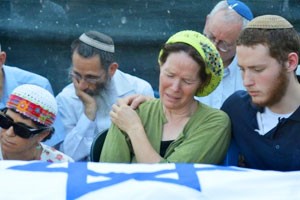
Cena comum em Israel – luto por entes queridos assassinados por terroristas palestinos.

Bem, querido mundo, analise a reação de um judeu comum de Israel. Em 1920, 1921 e 1929 não havia territórios ocupados em 1967 para impedirem a paz entre judeus e árabes. Na verdade, não havia nenhum Estado judeu para incomodar ninguém. Apesar disso, os mesmos palestinos oprimidos e reprimidos esquartejaram dezenas de judeus em Jerusalém, Jaffa, Safed e Hebron. Na verdade, 67 judeus foram massacrados num único dia, em 1929, na cidade de Hebron. Querido mundo, por que os árabes – os palestinos – massacraram 67 judeus num único dia em 1929? Será que foi por causa da fúria deles devido à agressão israelense em 1967? E por que 510 judeus, homens, mulheres e crianças, foram assassinados nas rebeliões árabes entre 1936-1939? Foi porque os árabes estavam abalados por causa de 1967?
Quando você, querido mundo, propôs em 1947, nas Nações Unidas, um Plano de Partilha que teria criado um "Estado Palestino" ao lado de um minúsculo Estado de Israel, os árabes gritaram "não", foram à guerra e mataram 6.000 judeus. Será que esse "incômodo" também foi causado pela agressão de 1967? E, por falar nisso, querido mundo, por que, na época, não ouvimos seu grito de "aborrecimento"?
Os pobres palestinos, que hoje matam judeus com explosivos, bombas incendiárias e pedras, são parte do mesmo povo que – quando tinha todos os territórios que agora exige para seu Estado – tentou jogar o Estado judeu para dentro do mar. As mesmas faces retorcidas, o mesmo ódio, o mesmo grito de "itbach-al-yahud" (massacrem os judeus!), que vemos e ouvimos atualmente, eram vistos e ouvidos naquela época. O mesmo povo, o mesmo sonho – destruir Israel. O que eles não conseguiram fazer no passado, sonham fazer no presente, mas não devemos "reprimi-los".
Querido mundo, você ficou indiferente durante o Holocausto. Em 1948, quando sete países deflagraram uma guerra, que a Liga Árabe orgulhosamente comparou aos massacres mongóis, você assistiu de camarote. Quando Nasser, barbaramente aclamado por uma turba selvagem em todas as capitais árabes do mundo, jurou atirar os judeus ao mar em 1967, você não se abalou. E você assistiria de camarote amanhã, se Israel estivesse enfrentando a extinção.
Como sabemos que os árabes-palestinos sonham todos os dias com essa extinção, faremos todo o possível para permanecermos vivos em nosso próprio país. Se isso o aborrece, querido mundo, bem – pense sobre quantas vezes no passado você nos aborreceu. Em cada evento, querido mundo, quando você se sente incomodado por nós, eis aqui um judeu em Israel que não lhe dá a mínima.
Ariel Ben Attar - Israel (http://www.beth-shalom.com.br)
As opiniões expressas nos artigos assinados são de responsabilidade dos seus autores.

EDITORIAL: Israel, O Presente - um momento entre o Passado e o Futuro

O Presente:
um momento entre o Passado e o Futuro


População judaica no mundo em 2010 e a exclusão dos judeus dos países árabes iniciada na década de 1930. Gráfico superior - The Economist; inferior direita - ECZP; inferior direita - Israel Science and Technology Directory.
Quando falamos da antiguidade pensamos em uma época que nos remete ao Egito dos Faraós e às pirâmides que ainda repousam no Vale do Nilo; a Atenas, a Esparta, aos Jogos Olímpicos e aos grandes filósofos. Também lembramos da Mesopotâmia e toda a primeira grande revolução científica do mundo. Alguns lembram da longa história dos chineses que tem registro de mais de 5.000 anos. Mas poucos vão comentar sobre os judeus.

No entanto, a maioria de nós já leu ou ouviu falar da Bíblia que relata exatamente a história dos judeus. Fica, então, a dúvida: por que não estudamos a história dos judeus na escola?  Por que nunca ouvimos falar das importantes contribuições que o Povo de Israel fez durante a antiguidade? Certamente a apropriação da história dos judeus pelas religiões que se originaram destes ensinamentos é a resposta mais direta, mas devem existir muitas outras, entre elas o fato de que os judeus que existem hoje são descendentes dos mesmos judeus que habitaram a Terra de Israel até o ano 70 da era comum, quando se iniciou o longo exílio imposto por Roma. 

Mas como é possível fazer esta afirmação? Há “provas científicas” em que podemos basear esta afirmação. Hoje, dia 1º de janeiro de 2018, será o dia das perguntas. “Prova científica” é um termo que a ciência rejeita, porque a ciência avança através do teste de hipóteses, isto é, do teste de perguntas e toda a resposta é válida. Se a hipótese é rejeitada, seguimos em frente por um caminho mais adequado, e se a hipótese não é rejeitada, os cientistas vão continuar testando na base de novos conhecimentos e novas tecnologias. E, desta forma, se a hipótese resistir aos vários testes, cada vez mais estamos confiantes que nossa pergunta original deve ser aceita, e neste caso passamos a ter uma teoria.

Há vários estudos arqueológicos que mostram a existência do Povo Judeu na época bíblica, e as diversas narrativas que são introduzidas ao longo do caminho.  Há vários estudos mostrando a relação do Povo de Israel com a chamada Terra Prometida. Ao longo deste ano de 2018, vamos mostrar alguns destes estudos nas nossas diferentes sessões. Mas na nossa opinião, a prova mais contundente e a mais inspiradora para nós, brasileiros, neste início de 2018 é a que define por que um povo disperso pelos 5 continentes, e que tem pessoas de diferentes etnias, é capaz de manter a sua história e a sua tradição e, principalmente, é capaz de se reconhecer ao longo da história.

Um judeu negro da Etiópia ou do Iêmen é reconhecido como tal pelos europeus e pelos chineses, e vice-versa. Pessoas muito diferentes quando se usa como base de comparação a cultura ocidental, mas que guardam traços comuns que permitem que se identifiquem, mesmo que outros creiam que são completamente diferentes. Serão hábitos alimentares? Serão hábitos de higiene? Em determinadas circunstâncias até pode ser. Muitos judeus seguem até hoje as recomendações bíblicas quanto ao preparo de alimentos e quanto à obrigatoriedade de lavar as mãos antes de tocar nos alimentos, ou após visitar cemitérios. Mas, são muitos, não todos.

Qual será a força motriz que, no caso dos judeus, transformou o presente em um hiato entre o passado e o futuro? A resposta aceita por todos os judeus e por muitos que convivem com os judeus é a importância dada à EDUCAÇÃO somada ao conceito de TIKUN OLAM. Ensinar aos filhos, de geração em geração, o que sabemos: a principal herança, aquela que nenhuma perseguição pode retirar. É o saber de uma geração transmitido à próxima. E nesta frase está o conceito de TIKUN OLAM. Olam quer dizer mundo – e TIKUN – que precisa de mais do que uma palavra para traduzir – quer dizer conserto, alteração, e, portanto, mudança. O mundo está em contínua evolução e cada geração deixa a sua marca. Esta, e mais todas as anteriores, devem ser repassadas para as próximas. O futuro deve ser baseado no passado e deve conter o presente. A negação do presente implica em descontinuidade e é neste hiato que as culturas são extintas.

Concluindo, o que transforma o presente em um momento de união entre o passado e o futuro é a obsessão do Povo Judeu pela educação e por considerar que cada geração representa uma continuidade.  Talvez seja esta a razão da longa sobrevivência, independentemente dos longos anos de diáspora terem somado ao povo original muitas etnias incluídas ao longo dos anos. Povo Judeu é um povo unido ao longo do tempo por sua herança cultural.

2018 – o ano da EDUCAÇÃO e do CONHECIMENTO.

terça-feira, 2 de janeiro de 2018

VOCÊ SABIA? - Documentário premiado sobre os judeus portugueses


Você sabia que o documentário "Caminhos da Memória – A Trajetória dos Judeus em Portugal", de autoria de Luize Valente e da fotógrafa Elaine Eiger, recebeu o Prêmio de Melhor Direção de Documentários no concurso New York Independent Film Festival em 2003?


Sinagoga em Lisboa


Bairro judeu de Trancoso - Portugal

“Uma viagem no tempo e no espaço em busca de respostas. Um passeio pelo território português atrás das marcas deixadas pelos judeus que lá viveram, foram forçados à conversão e morreram durante quase três séculos de Inquisição. Este documentário apresenta-se como um resgate das raízes judaicas portuguesas que podem ser apontadas como fundamentais na formação do povo brasileiro.”

Assistamos ao documentário:


São 56 minutos de filme que perfazem os últimos séculos da história de Portugal apresentando os judeus e conversos que se refugiaram no Brasil tentando escapar das atrozes e injustas perseguições do Santo Ofício, procurando abrigo e uma vida melhor e mais pacífica para seus dependentes.

Com sua bagagem cultural rica em conhecimentos científicos e comerciais, eles trouxeram ao novo continente seus preciosos ensinamentos associando-os às práticas e tradições dos aborígenes e dos escravos vindos da África.
Este documentário, baseado em pesquisas rigorosas e relatos atuais, relata a história dos judeus e cristãos novos que aportaram na nova terra portuguesa, já logo após sua descoberta por Cabral, e que muito contribuíram e participaram na formação deste novo país, o Brasil.


MEMORIAL DA IMIGRAÇÃO JUDAICA – SÃO PAULO

Este texto é uma colaboração de Itanira Heineberg para os canais do EshTá na Mídia.

FONTES
http://luizevalente.com/p/caminhos-da-memoria.html
http://www.google.com.br/search?q=judeus